

Have you ever felt that knot in your stomach when you open Google Maps and find a one-star review from someone who has never set foot in your office? This isn’t just a matter of professional pride. It’s an open breach in your commercial waterline.
In 2026, your reputation on Google Business Profile is, for many potential clients, more real than your actual nameplate on the door. A fake review attack can sink your conversion rate within hours: the client looking for a trustworthy lawyer sees that red mark, doesn’t ask questions, doesn’t investigate, and clicks on the next result on the list. That’s how brutal and real it is.
In this guide we’ll treat the problem for what it is: a reputation crisis that requires precision surgery. We’ll cover the technical side of Google, the Spanish legal route, and the preventive strategy so you can learn to identify, report, and ultimately neutralise those attacks that threaten the prestige you’ve worked so hard to build.
Do you want more clients for your law firm?
We are experts in legal marketing. Book your free consultation and together we will discuss how we can help you attract more clients.
The anatomy of a fake review: how to identify the digital aggressor
Before making a single move, you need to know what you’re up against. In the legal sector, fraudulent negative review profiles are recognisable if you know what to look for. Identifying them correctly is the first step to being taken seriously by Google when you report the content, and to choosing the right response route.
The unfair competitor
Generic reviews with no specific detail about any real case or interaction, whose sole purpose is to lower your average rating so that a competing firm stands out in local SEO. They’re recognisable by their extreme vagueness: “poor service”, “would not recommend”, with no concrete facts behind them. Sometimes the author’s profile has a history of positive reviews for competing firms, which exposes them completely.
The conceptual troll
The user who vents their frustration with the judicial system, with the opposing party’s lawyer, or with the process itself onto the first firm that appears on their screen. In Spain this is more common than it might seem: for this type of user, all lawyers are interchangeable and represent “the system”. They don’t know you, they haven’t worked with you, but they need to offload their anger somewhere.
The coordinated attack or click farm
If you detect ten one-star reviews in under two hours, it’s not a coincidence: it’s a planned operation. The indicators are clear: a sudden spike in negative ratings, profiles with no photo, no prior activity history on Google Maps, and often with names that don’t fit your local geographic market. This type of attack usually has a specific origin — either a dissatisfied client with financial resources or an unscrupulous competitor — and requires a response on two simultaneous fronts: technical and legal.
The technical route: Google’s management panel in 2026
Google has improved its moderation tools, but the process still demands flawless execution on your part. Flagging a review as “inappropriate” from your phone with a couple of taps is practically useless: it falls into automated filters and rarely reaches a human reviewer.
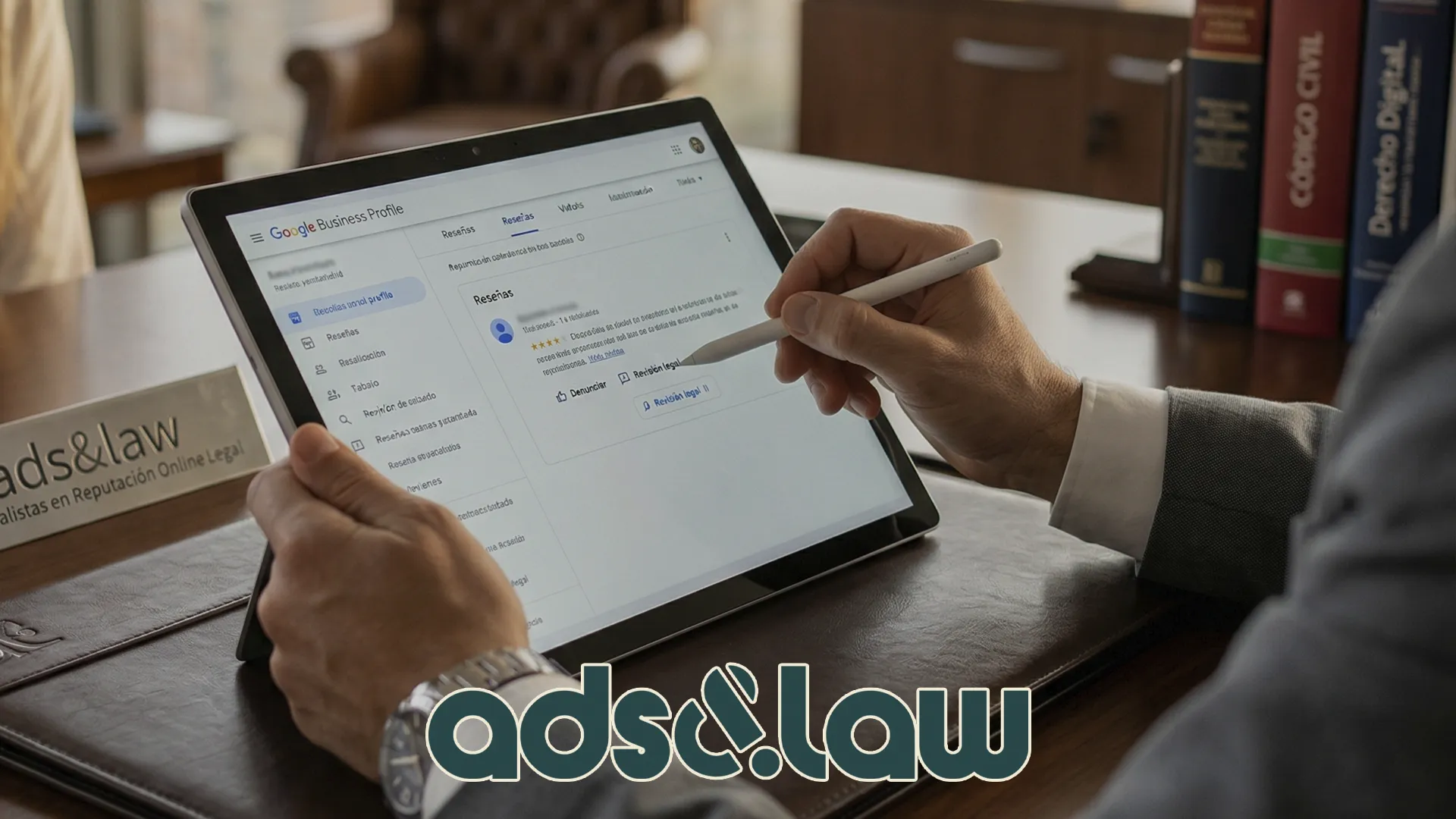
The correct process starts in the Review Management Tool within Google Business Profile, from a desktop computer. When reporting, select the category that best describes the case. In 2026, Google is especially responsive to the Conflict of interest and Harassment categories, which trigger higher-priority reviews than a simple “spam” report.
If Google rejects your initial request — which happens frequently due to automated algorithmic processes — you have a second chance: the manual appeal. This is where the battle is won or lost. Prepare screenshots from your case management software clearly showing that the person does not appear in your client database. If you can document that there is no trace of any commercial relationship with that profile, the likelihood of a human moderator removing the content increases significantly.
Do you want more clients for your law firm?
We are experts in legal marketing. Book your free consultation and together we will discuss how we can help you attract more clients.
What to do when Google repeatedly denies the report
It happens. Google’s moderation algorithm is imperfect and sometimes keeps clearly fraudulent content live for weeks. When the standard route closes, you have three moves available before escalating to legal action.
The first is Google’s legal assistance form, which is separate from the standard report. It’s designed for cases where a legally recognised rights violation exists, such as the right to honour or unfair competition regulations. It requires more documentation, but it reaches a different team.
The second is escalation via Google Business Profile phone support, available for verified accounts. Calling, explaining the case, and requesting a manual review with a case number is more effective than any automated form.
The third, and the most forceful step before going to court, is a formal legal notice sent to Google’s legal department. When their team receives a formal notification warning of the platform’s joint liability for maintaining unlawful content after having been duly notified, response times change dramatically. A well-drafted legal notice with solid legal grounds typically resolves in days what months of reports have failed to achieve.
The strategic response: the art of composure under pressure
Never leave a negative review unanswered while you wait for Google to act. But burn this into your mind: your response is not for the author of the review. It’s for the hundreds of potential clients who will read it afterwards to see how you handle conflict.
Avoid a defensive tone at all costs. A response that works in 2026 would be: “We regret your dissatisfaction, but after reviewing our case records we have found no consultation linked to your profile. We take the quality of our service very seriously and invite you to contact us to clarify this misunderstanding.”
That response does three things simultaneously: it projects transparency, it hints that you keep an organised client record, and for any external reader, it makes clear that this is likely an error or a malicious attack. You don’t argue, you don’t attack, but you don’t concede an inch of authority either.
The legal route: right to honour and unfair competition
When the technical route is exhausted, the Spanish legal system offers powerful tools that many lawyers forget to apply to their own situation. The Supreme Court’s case law is clear: freedom of expression does not protect gratuitous insults or the attribution of false facts that damage a third party’s professional standing.
Civil action for unlawful interference with the right to honour, under Organic Law 1/1982, allows you to seek not only the removal of the content, but also compensation for damages caused and a ruling that publicly clears your name. If the author is identifiable and is another professional in the sector, the Unfair Competition Act opens another front: spreading falsehoods to undermine a competitor’s reputation is a recognised, sanctionable practice that can prove very costly for those who attempt it.
To document the attack from the very first moment, don’t wait until you’ve decided whether to litigate. Take dated and timestamped screenshots, request a notarial record of the reviews if the scale of damage warrants it, and preserve all reports sent to Google along with their responses. That file will be the foundation of any subsequent action, whether judicial or extrajudicial.
Protecting your firm: the best defence is a flood of genuine stars
The smartest strategy in 2026 is not just to remove the bad, but to bury it under the good. A firm with a 4.9-star rating backed by 150 genuine reviews makes a fake review an irrelevant anomaly that Google’s own algorithm tends to filter out naturally. A firm with 12 reviews and an average of 3.8 is vulnerable to any minor attack.
Implement a review acquisition protocol at the moment of greatest client satisfaction: when a case is successfully resolved. A QR code in the office, a follow-up message a few days after closing, or simply asking in person during that shared moment of relief. The key is not the channel — it’s the timing.
Your brand is what Google says about you when you’re not in the room. Firms that take control of their digital reputation with the same methodology they use to prepare a trial are not improvising: they are building an asset that works for them around the clock. Start by documenting where you stand today and map out a plan for where you want to be in six months. The difference between a vulnerable firm and a protected one is not size — it’s discipline.
Is posting a fake Google review a criminal offence in Spain?
Yes, it can be. Publishing a fake review with the intent to damage a professional’s reputation or divert clients to a competitor may constitute several simultaneous offences under Spanish law: a criminal offence against honour through defamation or libel under the Penal Code, unlawful interference covered by Organic Law 1/1982, or an act of unfair competition if the author is another professional in the sector. Additionally, Google may permanently suspend the account of any user who publishes fraudulent content. Anonymity does not guarantee impunity: through judicial proceedings it is possible to request that Google Ireland identify the IP address and account data linked to the profile that authored the review.
Who should you take legal action against if Google won’t remove a fake review: Google Spain or Google Ireland?
Google Ireland Limited, headquartered in Dublin, which is the entity responsible for Google Maps and Google Business Profile services across Europe. A common mistake is directing claims against Google Spain, S.L., the subsidiary based in Madrid, which neither manages nor has the technical capacity to remove reviews. The good news is that Spanish courts have jurisdiction: the Barcelona Court of Appeal confirmed in 2023 that Google Ireland can be sued in Spain when the damage occurs on Spanish territory, in accordance with the EU Brussels I bis Regulation. Any formal legal notice or burofax must therefore be addressed to the Irish entity.
Can a lawyer ask clients for reviews without breaching professional secrecy?
Yes, provided it’s done carefully. Professional ethics do not prevent requesting a review, but they do require not disclosing details of the matter or pressuring the client. The key is to direct the request towards the treatment received and the overall experience with the firm, not the content of the case. A review that says “they explained everything clearly and I felt my situation was in good hands” is valid, ethically unimpeachable, and in fact far more persuasive for future clients than one describing details of the litigation. The optimal moment to ask is right after closing a matter with a positive outcome, when the client is at their peak of satisfaction.
How long does Google take to remove a fake review after it’s been reported?
There is no guaranteed timeframe and the variation is wide. A standard report may be resolved within a few days if the algorithm automatically identifies it as spam, but it can also remain under review for weeks or be rejected without explanation. Well-documented manual appeals — with screenshots and evidence that the author does not appear in the firm’s client database — significantly speed up the process. When escalated via Google’s legal assistance form or through a formal legal notice to Google Ireland’s legal team, response times are considerably shorter than through the standard reporting channel.
Do you want more clients for your law firm?
We are experts in legal marketing. Book your free consultation and together we will discuss how we can help you attract more clients.